Wednesday, 5 October 2011

Decorating the Central Belt 4: Dalreoch (Dumbarton) and Donaldson


Dalreoch Primary School stands above Dumbarton (now in West Dunbartonshire) at the top of the Castlehill area of the town. It is a sublime piece of school architecture by Ninian Johnston, and dates from 1953-55. Johnston's practice designed numerous schools in the Glasgow area in the 1950s. What really makes Dalreoch exceptional is its murals by David Donaldson (1916-96). And the murals, when one looks at the monograph on Donaldson by W. Gordon Smith (1996) and notes their absence, are what make Donaldson stand out. Here, perhaps more than in the other Central Belt Decorations so far viewed, are works that appear both personal and historical, plus universal, national and local. Here are works about nurturing youth and nature for the sake of the future. Here are works that are in two distinct media and which adorn internal and external walls.

The first Dalreoch mural is the painted depiction of Queen Mary of Scots departing for France from Dumbarton Castle (1957). At the time of its creation the Coatbridge-born Donaldson was a young lecturer in painting at the Glasgow School of Art. He was yet to be head of painting and drawing there (from 1967), a member of the Royal Scottish Academy (1962) or 'Her Majesty's Painter and Limner in Scotland (1977). He was, however married and a father to three young children, the youngest two of whom had been girls born to his second wife, Maria, in 1950 and 1956 respectively. I do not know the history of the commission of the mural but what can be said is that Donaldson's celebration of young girlhood, of 'Mary/Maria', together with the escape to France to seek an alternative life and way forward, rings bells with his biography. Who knows who modelled for the five little Marys in the centre of the picture?


The Queen Mary mural is very large and very flat. It runs through two storeys of the school foyer and can be viewed from both ground and first floor. It is well lit. It depicts the royal galley harboured in Dumbarton and the Scottish royal party about to embark. They are accompanied by female minstrels and knights in armour. Banners and furled sails cross the composition dividing and fragmenting its scenes vertically and diagonally.


The soft blue tones and play of bold, undetailed forms and play of spaces/viewpoints creates an assemblage of parts that is gentle to perceive yet actually quite complex. The combinations of historic architecture and costume, animal and bird life, performance and pageantry, a sense of communal/cultural tradition (circle dance and church) and the joining of earth, sea and sky - almost on top of one another - make this an ingenious, eyecatching and stimulating work of postwar modern art. It looks back and it looks forward, with balance and grace. Perhaps it is possible to identify characters and places. That's probably not for me. But surely here, around the central full frontal little Mary, are: her mother, Mary of Guise; her chosen girl companions, Mary Beaton, Mary Seton, Mary Fleming and Mary Livingstone; Monsieur de Brézé, the emissary of the French king sent to take Mary safely to France; Mary's half-brothers James, John and Robert, and her guardians Lords Livingstone and Erskine (at least one of them). The action takes place in July 1548 when five year old Mary, already Queen of Scots, was spirited away to France to avoid marriage with Henry VIII's son and thereby Scottish union with Tudor England. It would be interesting to know what sources (historical portraits or other) Donaldson drew upon for his characters... and whether, given the national flavour of this work, he considered his subsequent appointment as painter to Queen Elizabeth II with any sense of irony. It would also be worth trying to see how his mural sits in relation to his other works (not very closely on first glance) and their mid-twentieth century art context. My colleague Tom Normand has indicated some similarities with, for example, Wyndham Lewis's medievalist yet contemporary 'Surrender to Barcelona' (1934-7), which had been in the Tate since 1947.


The second Dalreoch mural is ceramic. It covers an entire south-facing wall that, windowless, overlooks the old school playground with its largescale game of snakes and ladders. The subject here is the story of Noah's Ark, though the ark is rather diminutive and peripheral. This appears easier to relate to Donaldson's other work, being comparable to some of the Nativity scenes he had drawn in the mid-forties. Perhaps, as Tom N has also suggested, it could be related to John Maxwell's mid-century work. The mural is signed 'David A Donaldson, For Ninian Johnston, Fired by James Crawford, 1957'. Again avoiding conformative scale, proportion and perspective here the composition is focused on the old bearded Noah who is surrounded by animals and flowers. The flood appears tranquil.


There is a childlike simplicity in the frontal and profiled figures of horse, lion, alligator, sheep, camel, cow, hen, monkeys, giraffes, goat and birds, as well as the wispishness of the lines and the sense of 'unfinish' in the white ground. There is also a small, playful, full frontal mermaid with arms and tail raised in the water to the far right. The variety of flora and fauna could be taken as a natural history lesson, while the Biblical subject occurs in numerous religious traditions, is open to a wide variety of interpretations with regard its meanings, and has been the subject for artistic recreation for centuries. Rarely, however, has been so monumentally produced, especially in modern times. It is somehow nice that the alligator's head enters a 'graffiti' goal. Just as at Wardie School, Edinburgh (see post of 16 September) where Alice in Wonderland is joined to a basketball hoop, the mural both watches over and joins in children's games...

It is remarkable that the Dalreoch murals have survived and are in such reasonable condition. Conservation is clearly an issue, with signs of deterioration becoming visible. They are testament to the vigour, creativity, optimism and investment in postwar education that was sadly not to last. Our appreciation of them has been made possible courtesy of headteacher Sat Bance. Many thanks to him.

In this whirlwind tour of the 'Decoration of the Central Belt' (Posts 1-4) an attempt has been made to select a variety of schools from different periods featuring different forms of art and created for children of different ages and abilities. Much can be learned, and by many (not just the children for whom they were made) from these attempts, whether modest or masterpieces.... To be continued...

Tuesday, 4 October 2011

Decorating the Central Belt 3: Eastwood High School (Newton Mearns), Robert Stewart and James Gorman


When Robert Stewart produced his ceramic mural for the entrance foyer of the new Eastwood High School at Newton Mearns, Renfrewshire, in 1965 he was head of Glasgow School of Art's Printed Textile Department and owner of Robert Stewart Ceramics Ltd. In many ways the mural reflects his dual interests, showing similarities in colour and form to his earlier work for the Edinburgh Tapestry Company and Liberty. This frequently featured abstracted sun-heads, patterned fish and birds, as well as a sense of flattened and vital organic growth.


The Eastwood mural seems to represent night and day, the elements, light overcoming (or at least interacting with) darkness, a sense of pagan calendar, and a rich interplay of cultural traditions or worldviews. It pulsates with hearts and sequins along and around a centralised horizon line.


The effect is of energy and a somewhat 'sixties' feel of psychedelic transcendentalism. Hugely appropriate for (and a relief from) the glazed concrete utilitarian palace of the new school (due for demolition in 2013).


Stewart was to produce three more murals for Scottish schools, and in somewhat similar vein, between 1965 and 1975 - Adelphi Street School, Glasgow (1965), Douglas Academy, Milngavie,(1966) and Glendaruel and Kilmodan Primary School (1975). My thanks to Catherine Davis for drawing my attention to these, and to Liz Arthur's Robert Stewart Design 1946-95 (2003), in which they feature.

Eastwood had a second mural created in 1965. It was placed at the back of Stewart's and on the wall of the hall behind it. This featured a battle from classical mythology, possibly the Trojan War (?), and was by James Gorman (1931-2005), a mural painting graduate from the Glasgow School of Art. After subsequently moving to Arran Gorman concentrated on easel painting, though he did apparently produce one more school mural - for the Moorcroft (?) Primary School in his native Gourock. It would be interesting to compare that, for younger children, with his treatment of history and conflict at Eastwood. The six fighting skeletal figures at the Renfrewshire school are made of coloured plaster and set against a glowing red-orange ground. The mural is currently kept, in three pieces, in a store below the school.

We are indebted to headteacher Stuart Maxwell and the janitors for bringing the Gorman out (for the first time in decades) for our visit, and indeed for making possible our viewing of both murals.


With the fate of the school sealed and no place for the murals in the new Eastwood set to open in 2013, a home for these historic works is urgently needed.

Decorating the Central Belt 2: Drumpark and Jessie King


Drumpark is a school for children with various kinds of learning needs, from nursery to senior ages. It is on the western edge of Coatbridge, at Bargeddie (now North Lanarkshire). It was designed by JR Stewart in 1925, has a butterfly-plan and must rank as one of Scotland's earliest open-air schools. It is both rational and picturesque, being adorned with pyramidal hexagonal entrance towers (with clerestory lighting) to both north and south, having south-facing verandas and classrooms with glazed sliding doors, and being one-storey. It was decorated by Jessie King and her husband E.A. Taylor. Renowned for their contribution to the so-called Glasgow Style in the early twentieth century, Drumpark continued a trend of designing for children that King had already been engaged upon for two decades (e.g. toys, illustrations, models). On 6 September 1927, The Glasgow Herald noted:

The outstanding feature of the school is the scheme of decoration adopted for the various classrooms.... A different design and combination of colour harmonies have been chosen for each classroom, and while there is fascinating variety, there is also a pleasing unity in the entire scheme.
It was a happy inspiration on the part of the artists to choose wild flowers in each case as the basis of the scheme. In one room, for example, the motif is that of forget-me-nots. The colour most in evidence is, of course, the pale blue of this favourite flower, while the wall decoration consists of forget-me-not flowers, among which there flit elusive elf-like figures. 'Wild Rose' is another motif which, in soft shades of pink, lends itself admirably to imaginative treatment of this description. There is a 'Primrose' classroom in pale yellow, and a 'Daffodil' and a 'Crocus' room in varying shades of the same colour, while 'Snowdrop', 'Old Rose', 'Gorse' and other flowers all receive appropriate treatment. Not only are the decorations of the various rooms soundly and simply conceived and executed as designs, but, more important still, they are calculated to appeal strongly to the imagination of children...'

Colin White, in The Enchanted World of Jessie M. King (1989), has noted the following:

'in the autumn of 1925 he [E.A. Taylor – husband of Jessie King] and Jessie had been invited to design the interior decorations for a new experimental nursery school that the Lanarkshire authorities were building at Drumpark for handicapped children. The Taylors were given a free hand, and decided to base their designs on flowers. Ernest chose the colour schemes and Jessie prepared stencilled friezes for the walls, with elves and fairies playing among clusters of 'Primrose', 'Snowdrop', 'Old Rose' and the other flowers that were used as names for the classrooms. In 'Sunflower', for example, elfin soldiers, in armour made of sunflower petals, fought one another by the light of a rising sunflower sun. Jessie paid several visits to the school to get the feel of the siting of the murals and their scale. She made large preliminary sketches of her compositions in charcoal and colour washes and, from these, made detailed paintings in gouache. The actual cutting of the stencils was done under her supervision by the firm of decorators who were painting the school, and she and Ernest attended to the mixing of the colours they had decided on… It was the first time that children's taste had been given consideration in the planning of a new school. The success of the venture encouraged the Lanarkshire authorities to repeat the experiment the following year at Machen [now Machanhill?], a new school at Larkhall, and the Taylors were invited again to plan the décor for the seven classrooms for the youngest children… Jessie painted one of her few oils, Little Brown Seed, for Drumpark School….'

While the classroom decorative scheme has vanished, the 'Little Brown Seed' mural survives. Its text is from Edith Nesbit (of Railway Children and Fabian Society fame) - in fact it is her poem called Baby Seed Song. This is both written (in Glasgow Style capitals with dots between words) and illustrated (by anthropomorphic poppy and sunflower seeds in a slightly oriental stylised birch grove). The poem and mural are still used as reading and learning resources today.

In 2009 the school installed, at the end of a corridor, a ceramic mural made of ten hexagons by the children (under the supervision of ceramicists Fiona Fleming and Julia Smith) and depicting various facets of Drumpark life, past and present. It makes a fitting accompaniment to Jessie King's work.

Drumpark is about to close and the future of the building is uncertain. Andrew D and I are very grateful to Mrs Millar, Miss King, Mr Doherty and the Headteacher for sharing with us their tremendous appreciation of the school.

Decorating the Central Belt 1: Kilsyth and Tom Whalen


Kilsyth Academy (now in North Lanarkshire) was designed by Basil Spence and constructed either side of the Second World War. In September 1948, just as building recommenced after a nine year break, a model of the school was shown at the 'New Schools' Exhibition at the McLellan Galleries, Glasgow. The exhibition organisers, the Scottish Committee of the Council of Industrial Design and the Royal Incorporation of Architects in Scotland, were 'both convinced that Mr Spence's design may well set an entirely new standard for school construction in the country. Emphasis is all on sunlight both in classrooms and in the grounds...' (The Scotsman, 16 September 1948).


On a hilltop overlooking the town and Kilsyth valley, the Academy appeared as a functionalist castle rising up from a series of landscaped terraces and dominated by a high cuboid clock tower.


The rendered latter was adorned with an emblematic clock (note the symbols of learning), and a relief of 'Education' by Tom Whalen.


The relief, with its flattened symmetrical figures, acts as a counterpoint to the large rectangular hall and stair window beside it. Both are enclosed within the same cement surround. Whalen's large carving shows a couple in profile standing on a voluted pedestal presenting their infant son to the sun (world, universe...). The full frontal nude boy is lifted effortlessly up, his arms and face raised to the sky. Defying gravity he perches on the fruitladen boughs of a stylised tree (of knowledge? of life?), with fluted column trunk.


Whatever their religious-secular-education associations, the simplified figures recall Whalen's pre-war 'Mother and Child' fountain at Prestonfield Primary School, Edinburgh (see post of 3 February 2011) while the 'sun-worship' posing suggests that of the symbolic bronze ballerina with which he adorned the then new (now demolished) Dalkeith High School in 1960 (moved to new Dalkeith High School in 2004). Taken together these three commissions, completed over a period of twenty-five years, mark Whalen out as the foremost sculptor for mid-twentieth century Scottish schools.

The photographs of Dalkeith are reproduced courtesy of RCAHMS. Andrew D and I visited Kilsyth on 30 September 2011. We are grateful to Headteacher Gillian Caldwell and Depute Head Paul Reilly for their invaluable guidance and insights.


Saturday, 24 September 2011

The School Prints

Thanks to Pete Medway for putting me on to this site


One of the prints is The Harbour which is one of the murals we have discussed here by Trevelyan.

see 'films' on the site too.

Cathy

Wednesday, 21 September 2011

Wardie School, Edinburgh and its ‘Alice in Wonderland’ mural


2011 is the eightieth anniversary of the opening of Wardie Primary School on Granton Road, Edinburgh. It is also the seventy-fifth anniversary of the painting of a large, nine-panel, mural in its hall. The Decorated School Network is joining forces with the school to celebrate the latter and to this end we are organising a day in the school on Saturday 29th October (details to follow in the Events link on this page). The event will start around 1030 and finish around 1530 (exact times tbc). It will be open to all with interests in the school's history and the significance of/reasons for adorning schools with striking imagery. It is hoped that through drawing attention to the historical importance of the mural (it is unique in many ways) means and funds will be raised for its restoration and conservation.

The Scotsman (16 September 1931) provided considerable coverage of Wardie's opening in 1931. Particular attention was paid to its construction in an area where 800 houses had been recently built, that it was made of '750000 bricks', that the architect was Joseph Marr Johnston.

'The school is planned on the open-air principle around an inside garden. It is a one-storey building except in the front. There are 15 classrooms, with accommodation for 750 pupils, a sewing room, and a large hall or gymnasium. The style of the building from the outside is more suggestive of buildings more common on the continent and in the south of England than in Scotland, for the exterior walls are of red brick, with 'panels' of white harling, and the window frames are painted green.' The article also noted that in the central garden there would be 'lawns, crazy paving and flowerbeds' while there were already 'friezes on the walls of its infant classrooms on which are depicted fairy tales and rhymes'.


Five years later, under the 'Schools Beautiful' scheme initiated by Edinburgh Education Committee and Edinburgh College of Art, a postgraduate Andrew Grant Fellow of ECA, Robert Heriot Westwater (1905-62), painted the Wardie mural of Alice in Wonderland. The inspiration behind the scheme appears to have been the then Principal of ECA, Hubert Wellington. Westwater was extraordinarily active around this time, both as a painter, lecturer, art teacher and broadcaster. Appreciation of his contribution to Scottish art history is long overdue. The Wardie mural appears to be the first of Westwater's ventures into largescale wall painting. It was followed by his mural decoration of the ICI Pavilion at the 1938 Empire Exhibition in Glasgow and, in 1939, of a mural in the workers' lecture hall at Musselburgh Wire Mills.


The 'Schools Beautiful' programme was cut short by the Second World War. In Edinburgh, as far as is currently known, just three schools benefitted - Craigmillar Primary School (John Maxwell's and Alexander Inglis's murals, 1935 and 1939 respectively), Prestonfield Primary School (Tom Whalen's bronze fountain group, 1935), and Wardie. Craigmillar and Prestonfield were to feature as optimistic signals of present and future directions for Scottish education combining with art in John Grierson's remarkable, and famous, documentary film about the progress of schooling, The Children's Story (1938). Actually, this appearance was preempted by Wardie. For just after Westwater had completed his mural it appeared in 'Education in Edinburgh', a Campbell Harper film, with scenario written by JB Frizell, City Education Officer, about Edinburgh's educational services. Reviewed in detail in The Scotsman (11 November 1936), I have been unable to trace a copy of this film. Any clues as to its whereabouts would be gratefully received.

The incorporation of the decorated Wardie, Craigmillar and Prestonfield Schools into these early films is evidence of their place as beacons for educational progress. Wardie also had in common with Prestonfield its open-air, health and hygiene, ideas and realisation. Furthermore Wardie acted as a precedent for Craigmillar in terms of mural subject, for Inglis's wall painting focused on a doll's house with scenes from 'Alice' (combined with episodes from Edward Lear's 'Nonsense' and traditional children's tales and rhymes). Unfortunately, Inglis's work has been painted over and while the Maxwell mural opposite it survives, the school has closed and been turned into apartments. This makes Wardie's mural, in a working school, all the more precious.

The unveiling of 'Alice in Wonderland' at Wardie was a grand affair. It was undertaken by JW Peck, Permanent Secretary to the Scottish Education Department in the company of representatives of Edinburgh Education Committee, College of Art and Council, together with a group of prominent artists, teachers and local schoolchildren. The ceremony, the mural and the ideas behind the scheme for art in schools which it symptomised was given substantial column and image space in The Scotsman (9 and 12 June 1936).


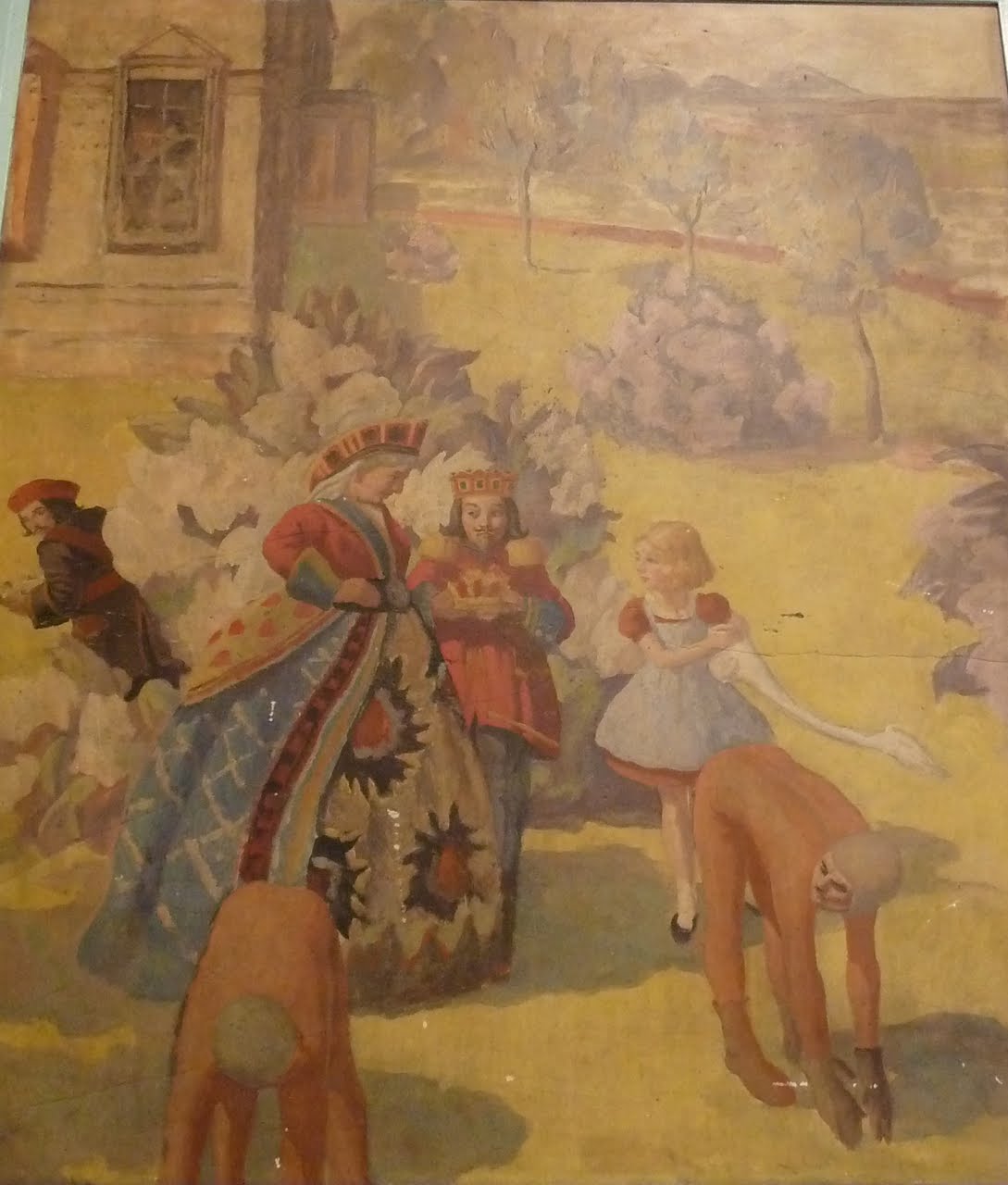
Westwater divided his mural into views of nine separate incidents in Alice in Wonderland. To some extent these bear a resemblance to John Tenniel's 1864 illustrations of Lewis Carroll's fantasy. Yet they move beyond those well-known black and white caricatures to recreate Alice in a novel painted fashion. A handwritten key to the panels, whose Italic script appears in columns akin to the format of the mural, is placed in the hall adjacent to the painting. The treatment of the scenes is colourful and figurative. As such it could be called fantasy realism. It captures the absurd yet learning world of Alice's adventures in a way that while easily readable defies, perhaps in keeping with the 'irrationalism' of Carroll's yarn, straightforward narrative reading from left to right or top to bottom.


Top Left - horizontal panel of Alice Falling Asleep while her sister reads a 'dry' book (Chapter One)

Bottom Left - vertical panel of The Game of Croquet with the Queen, King and Knave of Hearts (Chapter Eight)

Top Mid Left - horizontal panel of Alice, the Hookah-smoking Caterpillar and the Mushroom (Chapter Five)

Bottom Mid Left - vertical panel of Alice with animals wondering how to get dry (Chapter Three)

Centre - vertical panel with Alice and the Rabbit at the bottom of the Tunnel. Complete with Marmalade Jar and Golliwog (the latter, not being in Alice in Wonderland could be a cunning advertisement for Robertson's Jams and Marmalades?) (Chapter One)

Top Mid Right - horizontal panel of the Gryphon and Mock Turtle dancing the Lobster Quadrille (Chapter Ten)

Bottom Mid Right - vertical panel of Alice being grinned at and instructed by the Cheshire Cat (Chapter Six)

Top Right - horizontal panel of Alice awoken by her sister (Chapter Six)

Bottom Right - vertical panel of the Tea Party with the Mad Hatter, March Hare, Dormouse and Fish Footman (Chapter Seven)


The 'transcendent' Wonderland mural was to act in several ways - to enliven the school environment, as a pedagogic tool and as part of a modern, twentieth century campaign to revive mural art for public service. It still leaves an impression. Just as the basketballs missing the mobile hoop and board attached to it around the central white rabbit make their impression on it. I think Westwater might have approved...

While the empty places at the mad hatter's party table in the lower right panel hint that it might not be everyone's cup of tea, with its mural and its school Wardie has something exceptional and experimental. It is a testament to the vision and ideals of early twentieth century social reformers.

Sunday, 18 September 2011

Strathmore Infants, Hitchin A mural in the life of the school, then and now

Strathmore Infant and Nursery School, Hitchin, is a modernist and imaginative new building by Hertfordshire County Council architects. Attractively landscaped, it was opened on 22 October 1949, by Lady Allen of Hurtwood who acclaimed it a ‘most lovely school’.


Painters Kenneth Rowntree (who created a mural at Barclay School, Stevenage) and Charles Mahoney visited with Mary Hoad (Arts Organiser, Herts Education Office) in June 1949, prior to the commission. Then Malcolm Hughes, about to graduate at the Royal College of Art, was given the task and completed it in February 1950. He was one of the students also selected to assist with large-scale murals in the Law Courts. School logbooks mention a BBC film made at the school in November 1950, not yet traced. The director was John Read, son of Herbert Read. It was one of his first films, shortly after meeting the great filmmaker John Grierson, and he went on to specialise in documentaries on artists. Jeremy Howard refers to this in his report of the visit, below, and we will try to trace a copy of the film.


Occupying a recess midway along a wide lateral thoroughfare, the mural is seen regularly by children in passing, but as they move about the school, but is not in a location that invites prolonged contemplation, by contrast with the more common settings of foyer, assembly hall or dining room. Although set back from the circulation space and partly obscured by pillars it receives good light from the generously glazed corridor. This however is a wall behind the hall stage, a functional space, the painted wall including two doors to storage cupboards.


Malcolm Hughes mural: centre section


Malcolm Hughes had seen war service as a naval radio operator and inclined to Socialist Realism. The Strathmore mural represents his figurative early work before the abstract constructivism that he developed in the sixties and for which he became well known. The figures of children at play echo the style of Stanley Spencer. But there is already a tendency to abstraction in the mural as the playground equipment, goal posts, ice cream seller’s bicycle and railway viaduct and equipment in background are reduced to formal shapes that articulate the composition. Stephen Bann hints at an ideological element in Hughes’ personality and work, as ‘that rare thing among British artists: a creative thinker who openly rejected individualism and sought to foster collective strategies for the production and display of works of art.’ (Obituary, Independent 25 September 1997) Hughes’ works (mostly constructivist paintings) are in many collections, including at the Tate, Warwick University, Manchester City Art Gallery, Sussex University and the British Council.


Full of activity, the painting shows children in a local park. The topic suits a busy corridor, a scene to accompany constant movement, a picture the children will get to know through frequent fleeting acquaintance as they go between classroom, hall and playground. The setting was identified as Ransom’s recreation ground with recognisable features of play equipment, football goal posts and a railway viaduct in the background. This landscape background, stylised and abstracted in its representation, was readily recognisable in going on to visit the park, where mature foliage now hides the railway features.

Ransom’s Recreation Ground

A lot of discussion in previous blogs has focused inevitably on the commissioning, authorship and subsequent fate of murals, and analysis of styles, sources and influences. At Strathmore our discussion turned to the content of a mural depicting the everyday lives of local children at the time it was painted, and influences it have had on art in the school since that time.


Conversation provoked by the painting turned on children of the late 1940s, as observed by Hughes. Curiously for an infants school mural, these are junior age children. Several children surround an ice cream vendor and his bicycle, one offering an ‘old penny’ in payment. The health service of the post-war welfare state is celebrated in one bespectacled child and another with a bandaged knee, all the children comfortably dressed and shod by contrast with the more impoverished figures familiar in images of earlier generations. A boy wears football boots and shin pads are visible above his socks, a school cap, a tie and a scarf on different children are grey and maroon, probably the uniform colours of the Wilshere Dacre school at that time.


The mural's influence on the later life of the school may be reflected in a mural tradition still evident on the walls. A large mural at one end of this transverse corridor, painted by a teacher some time in the 1990s represents characters from the hugely popular ‘Oxford Reading Tree’ books by Roderick Hunt and Alex Brychta, that would have been most infants’ introduction to reading at that period. Also enlivening the corridor walls is a brightly coloured series of ceramic mosaics designed and made collaboratively by children working under the guidance of an artist in residence. The themes are taken from popular books.